
Why Manual AML Checks are Dragging Down Your Instruction Speed
It’s Tuesday morning, 9:15 AM. You’ve just come back from a valuation on a beautiful four-bed detached in a prime postcode. The vendor is keen: they want to be on the market by Friday to catch the weekend browsers on Rightmove. You’ve got the photos booked and the floorplan drafted. Then comes the "bottleneck." Your […]
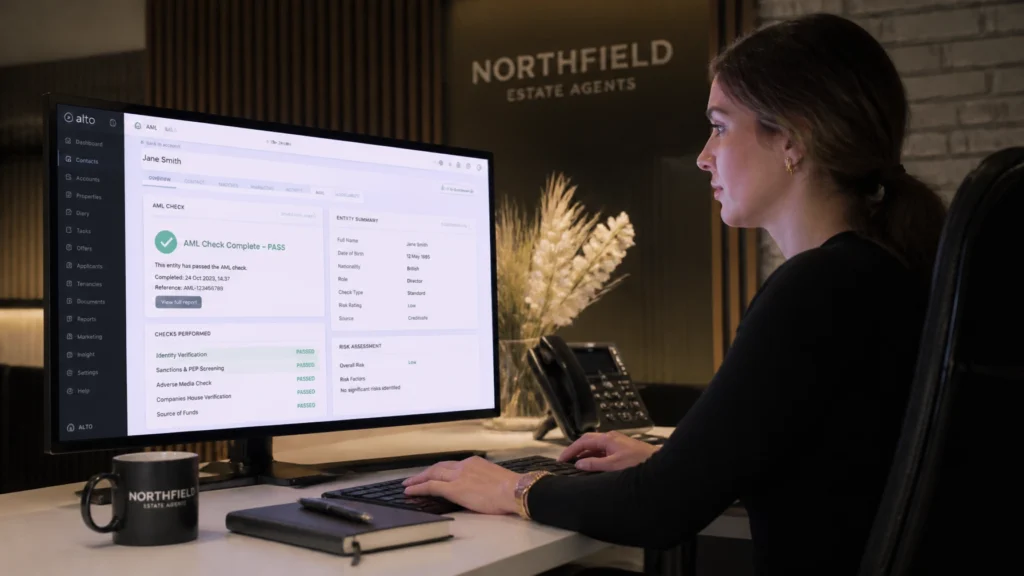
It’s Tuesday morning, 9:15 AM. You’ve just come back from a valuation on a beautiful four-bed detached in a prime postcode. The vendor is keen: they want to be on the market by Friday to catch the weekend browsers on Rightmove. You’ve got the photos booked and the floorplan drafted.
Then comes the "bottleneck."
Your administrator, Sarah, starts the manual Anti-Money Laundering (AML) process. She sends an email asking for a passport copy and a utility bill. The vendor is at work, forgets to reply until Wednesday night, and then sends a blurry photo of a driving licence that expired three months ago. By the time you get a clear copy of a valid ID and manually check the PEP and sanctions lists, it’s Friday afternoon. The "For Sale" sign isn't up, the listing isn't live, and your vendor is calling you, frustrated that they’ve missed the window.
In my 10 years on the agency floor, I’ve seen this play out hundreds of times. We treat AML as a "compliance task" to be ticked off, but in reality, manual Customer Due Diligence (CDD) is a massive operational anchor that drags down your instruction speed and costs you momentum.
The problem: The manual AML paper trail
Manual AML checks aren't just slow; they’re fundamentally disconnected from the pace of a modern agency. When you're relying on a manual process, you’re essentially running a 1990s compliance department inside a 2026 digital business.
The friction starts with document collection. Asking a client to bring physical documents into the branch or: worse: sending sensitive ID copies over unencrypted email is a terrible customer experience. It’s high-friction for the vendor and high-risk for you under GDPR.
Once you actually have the documents, the manual work really begins. A staff member has to:
- Visually verify the ID (which, let’s be honest, we aren't trained to do like forensic experts).
- Manually search PEP (Politically Exposed Persons) and sanctions databases.
- Cross-reference the information with your CRM, like Reapit or Alto.
- File the proof in a way that is "audit-ready" for HMRC or Propertymark inspections.

This "risk-based approach" often turns into a "guess-based approach" where different negotiators apply different standards. If your MLRO (Money Laundering Reporting Officer) is out for the day or tied up in meetings, an instruction can sit in "pending" limbo for 48 hours. That is 48 hours where your competitor could be swooping in with a faster, slicker onboarding process.
What this costs your agency
The true cost of manual AML isn't the £5 or £10 you pay for a basic electronic search; it’s the lost opportunity cost.
For an agency handling 20 instructions a month with an average commission of £5,000, every day a property isn't on the market matters. If manual AML adds an average of 3 days to your "valuation-to-listing" timeline, you are effectively losing 60 days of active marketing time every month across your pipeline.
Think about what that does to your conversion. In my experience, the "instruction honeymoon period" lasts about 72 hours. That’s the window where the vendor is most excited and most likely to recommend you. If those 72 hours are spent chasing them for a council tax bill, you’ve killed the vibe before the first viewing.
Furthermore, manual processes are prone to "lead leakage." While you're fumbling with paper trails, the vendor is still seeing ads for the "hybrid" agency down the road that promises a 24-hour listing. You aren't just fighting for the instruction; you're fighting for the vendor's confidence in your digital-first operations.
How AI and automation fix the instruction bottleneck
The solution isn't just "buying an AML tool." It’s about building an automated workflow that connects your CRM, your client, and the compliance check into a single, frictionless loop.
When we talk about AI for estate agents, we’re talking about agentic workflows that handle the heavy lifting while you're at the valuation. Here is what a high-performance, automated AML flow looks like:
- Trigger-based Onboarding: The moment you mark a valuation as "Instructed" in your CRM, an AI-powered workflow triggers a secure link to the vendor via SMS and email.
- Biometric Verification: The vendor completes a biometric ID check on their phone in 60 seconds: taking a photo of their passport and a "liveness" selfie. No more blurry emails or office visits.
- Automated Screening: The system instantly screens against global PEP and sanctions lists, verifies the address against credit headers, and flags any discrepancies to your MLRO in real-time.
- CRM Integration: The "Pass" certificate is automatically uploaded to the correct contact record in Reapit or Alto. The status changes from "Pending" to "Ready to Market."
- Instant Notification: Your lister gets a Slack or email notification: "AML Passed for 12 High Street. You are clear to go live."

This takes the process from three days down to three minutes. It removes the human error and ensures you are 100% compliant with HMRC requirements without slowing down your revenue. More importantly, it frees up your administrators from the "document chase" and allows them to focus on sales progression and client care.
What this looks like at Nexform AI
We don’t believe in generic "AI bots." We build practical, rugged automation for the problems we lived through in the agency world. When we work with a firm on AML automation, we don’t just give you a piece of software; we build the bridge between your CRM and your compliance requirements.
Our typical engagement starts with a Discovery call where we map out your current instruction-to-listing flow. We identify where the "leaks" are: is it the document chase? The UBO (Ultimate Beneficial Owner) checks for complex company sellers? The manual filing?
From there, we usually run a Pilot (£3k–£8k) where we automate one specific part of that flow: for example, the vendor onboarding for a single branch. Once the Pilot proves that we’ve cut two days off your listing time, we move to a full Build where the automation is scaled across your entire network, fully integrated with your existing tech stack.

Stop chasing ID and start chasing instructions
Compliance shouldn't be the enemy of growth. If your team is spending their afternoons chasing utility bills instead of closing deals, your operational model is broken.
By moving to an automated, AI-assisted AML workflow, you aren't just "staying legal": you're becoming the fastest agency in your town. You’re giving your vendors a slick, modern experience that justifies your commission and proves you're a 2026 business, not a 1996 one.
If manual AML and onboarding friction are costing your agency instructions, and you'd like to see what a fully automated "Instruction-to-Live" workflow could look like for your specific CRM setup, book a 30-minute Discovery call. We'll walk through your current process, identify the bottlenecks, and outline what a Pilot would cover. No slides, no pitch: just a working conversation between two people who know the industry. [Book Discovery call]
Phil Yassein is the founder of Nexform AI. He spent 10 years in UK estate agency before building AI automation specifically to fix the operational problems he lived with. Nexform AI is an approved Crown Commercial Service supplier and works with UK agencies on Discovery, Pilot and Build engagements.
{“@type”:”BlogPosting”,”image”:”https://cdn.marblism.com/goKdqPLf4q8.webp”,”author”:{“name”:”Phil Yassein”,”@type”:”Person”,”jobTitle”:”Founder”,”affiliation”:{“name”:”Nexform AI”,”@type”:”Organization”}},”@context”:”https://schema.org”,”headline”:”Why Manual AML Checks are Dragging Down Your Instruction Speed”,”keywords”:[“AI for estate agents”,”Estate agency automation”,”AML automation”,”UK property industry”,”Reapit automation”,”Alto integration”],”publisher”:{“logo”:{“url”:”https://nexformai.co.uk/logo.png”,”@type”:”ImageObject”},”name”:”Nexform AI”,”@type”:”Organization”},”description”:”Former estate agent Phil Yassein explains how manual AML checks create instruction bottlenecks and how AI automation can reduce listing times from days to minutes.”,”datePublished”:”2026-06-16″,”articleSection”:”Estate Agency Automation”}
Turn insight into operational improvement.
Nexform AI helps organisations identify automation opportunities, reduce repetitive workload and design secure AI-powered workflows.